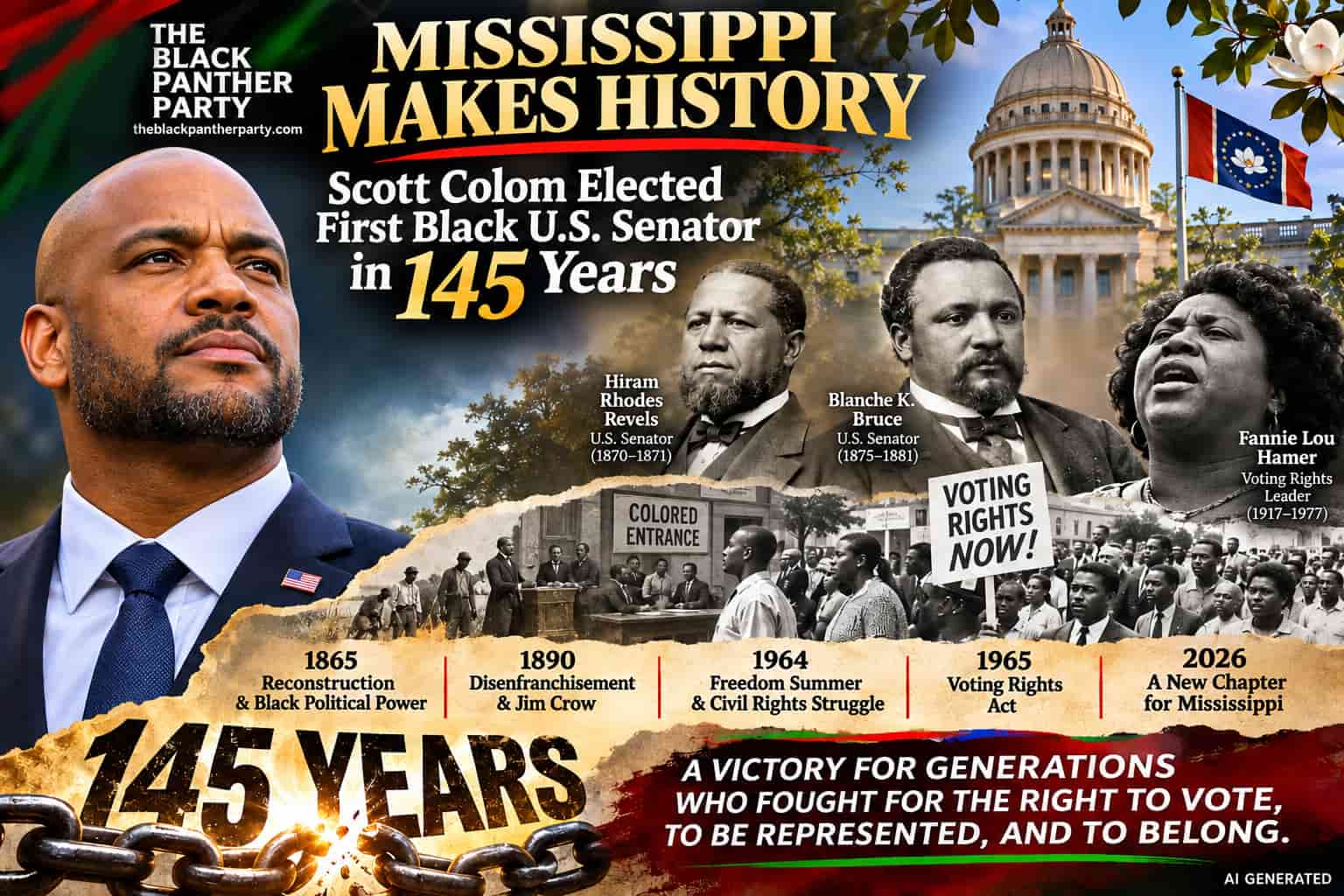
Mississippi elects its first Black U.S. senator since Reconstruction, marking a historic chapter in a state where generations fought for the right to vote, hold office, and participate equally in American democracy.
By The Black Panther Party Editorial Team | November 11, 2026
A Historic Election in Mississippi
On November 11, 2026, Mississippi entered a new chapter of American political history.
Scott Colom, a 43-year-old district attorney and Democratic candidate for the United States Senate, was declared the winner of a closely contested election against Republican incumbent Cindy Hyde-Smith.
With that victory, Colom became the first Black person elected to represent Mississippi in the United States Senate since the Reconstruction era.
The last Black senator from Mississippi, Blanche Kelso Bruce, left office on March 3, 1881.
One hundred and forty-five years have passed.
That extraordinary interval is more than a historical curiosity. It encompasses the rise of Jim Crow, the systematic disenfranchisement of Black citizens, racial terror, the civil rights movement, and generations of political organizing.
To understand the significance of Colom’s election, one must understand what happened to Black political representation in Mississippi—and why it took so long for another Black Mississippian to reach the Senate.
Reconstruction: When Mississippi Helped Lead Black Political Representation
Following the Civil War, formerly enslaved Americans began exercising political rights that had been denied to them for generations.
Mississippi became an important center of Black political participation during Reconstruction.
In 1870, Hiram Rhodes Revels became the first African American to serve in the United States Senate. He represented Mississippi, a state that had been among the most committed defenders of slavery and secession.
Revels advocated educational opportunities, civil rights, and greater political inclusion for Black Americans.
Five years later, Blanche Kelso Bruce was elected to a full six-year Senate term. Bruce, who had been born into slavery, served from 1875 until 1881 and became the first Black American to preside over the Senate.
Their achievements were part of a broader transformation.
According to the Mississippi Department of Archives and History, at least 226 Black Mississippians held public office during Reconstruction.
For a brief period, the political possibilities of emancipation were becoming reality.
But those possibilities faced organized and increasingly violent resistance.
The Destruction of Black Political Power
The end of Reconstruction did not simply produce a change in political leadership.
It marked the beginning of a sustained campaign to strip Black citizens of the political rights they had recently gained.
White supremacist organizations employed intimidation, economic coercion, and violence to discourage Black political participation.
In 1890, Mississippi adopted a new state constitution that institutionalized barriers to voting.
Poll taxes, literacy tests, and other restrictions were administered in ways designed to exclude Black voters.
These measures became a model for disenfranchisement throughout the South.
The consequences were devastating.
Black Mississippians who had helped elect legislators, statewide officials, and United States senators were systematically pushed out of the political process.
The resulting absence of Black representation was not evidence of political indifference.
It was the consequence of deliberate exclusion.
Mississippi’s Long and Violent Struggle for Voting Rights
Throughout the twentieth century, Black Mississippians continued challenging segregation and political disenfranchisement.
Their struggle carried extraordinary risks.
Medgar Evers, the NAACP’s Mississippi field secretary, was assassinated outside his Jackson home in June 1963.
The following year, Mississippi became the center of Freedom Summer, an ambitious campaign to expand Black voter registration and political education.
Civil rights organizations, including the Student Nonviolent Coordinating Committee, the Congress of Racial Equality, and the NAACP, worked alongside local communities to challenge racial exclusion.
Resistance was frequently violent.
On June 21, 1964, civil rights workers James Chaney, Andrew Goodman, and Michael Schwerner were murdered by Ku Klux Klan members in Neshoba County.
Their deaths became an enduring symbol of the dangers faced by those working to secure voting rights.
Yet the movement continued.
Fannie Lou Hamer, a former sharecropper from Mississippi, emerged as one of the nation’s most influential voting-rights advocates.
Her testimony before the 1964 Democratic National Convention exposed the violence, intimidation, and exclusion confronting Black voters.
The Voting Rights Act of 1965 subsequently established powerful federal protections against racial discrimination in voting.
Those protections did not erase the past, but they fundamentally altered the legal framework within which Black Americans could exercise political power.
The Road to 2026
Scott Colom’s victory occurred against this historical backdrop.
Before running for the Senate, Colom served as district attorney for Mississippi’s 16th Judicial District.
His campaign emphasized economic concerns, including household costs, agricultural policy, and the interests of communities that he argued had been overlooked by Washington.
The contest also carried an unusual personal dimension.
In 2023, Hyde-Smith opposed Colom’s nomination to a federal judgeship, preventing it from advancing under the Senate Judiciary Committee’s customary blue-slip process.
Three years later, Colom challenged her for the Senate seat itself.
The November 3 election remained unresolved for more than a week as officials counted outstanding absentee and affidavit ballots.
Colom’s narrow lead eventually produced projections and race calls in his favor on November 11.
His victory also marked the first time Mississippi had elected a Democrat to the U.S. Senate since 1982.
A Victory That Belongs in a Larger History
Colom’s election is an individual achievement, but its historical meaning extends beyond one candidate or political party.
Mississippi’s Black political history did not begin in 2026.
It includes the formerly enslaved citizens who registered to vote during Reconstruction, the Black legislators who served despite threats, the organizers who challenged Jim Crow, and the families who persisted through generations of exclusion.
It also includes the many Mississippians—Black and white—who worked to build a more inclusive political system.
The election demonstrates how dramatically the possibilities for political representation have changed since the nineteenth century.
At the same time, the passage of 145 years between Black senators raises difficult questions about the persistence of inequality in American political institutions.
Representation alone cannot resolve disparities in education, health care, wealth, criminal justice, or economic opportunity.
Those issues require policy decisions, public accountability, and sustained civic participation.
Colom’s work in the Senate will ultimately be measured by his record, including how effectively he represents the people of Mississippi.
The Responsibility of Historical Memory
The history of Black voting rights in Mississippi must never be reduced to a collection of dates.
Behind those dates were people whose lives were shaped by discrimination, violence, resistance, and determination.
Some were elected to office.
Others organized voter-registration drives, taught citizenship classes, challenged discriminatory laws, or opened their homes to civil rights workers.
Some paid with their lives.
Their contributions helped make the political possibilities of 2026 achievable.
Remembering that history is not simply an exercise in looking backward.
It provides essential context for understanding the responsibilities of democracy today.
A New Chapter, Not the End of the Story
The Black Panther Party recognizes the historical significance of Scott Colom’s election and extends congratulations to the senator-elect on this milestone.
His victory closes a remarkable gap in Mississippi’s representation in the United States Senate.
But history also reminds us that political milestones do not automatically guarantee substantive equality.
The principles of equal protection, political participation, community empowerment, and accountability remain as important today as they were during Reconstruction and the civil rights movement.
Scott Colom now has the opportunity to serve a state whose history includes both extraordinary injustice and extraordinary courage.
The people of Mississippi will determine how this new chapter unfolds, and the senator-elect will have the responsibility of representing them.
One hundred and forty-five years after Blanche Kelso Bruce left the Senate, Mississippi has elected another Black senator.
That fact deserves recognition.
The history behind it demands remembrance.
And the work of building a democracy in which every citizen enjoys equal rights and meaningful representation continues.
The Black Panther Party Editorial Team
Historical context and reporting: U.S. Senate Historical Office; Mississippi Department of Archives and History; National Archives; U.S. Department of Justice; Associated Press; Reuters; Mississippi Today.