Category: Commentary

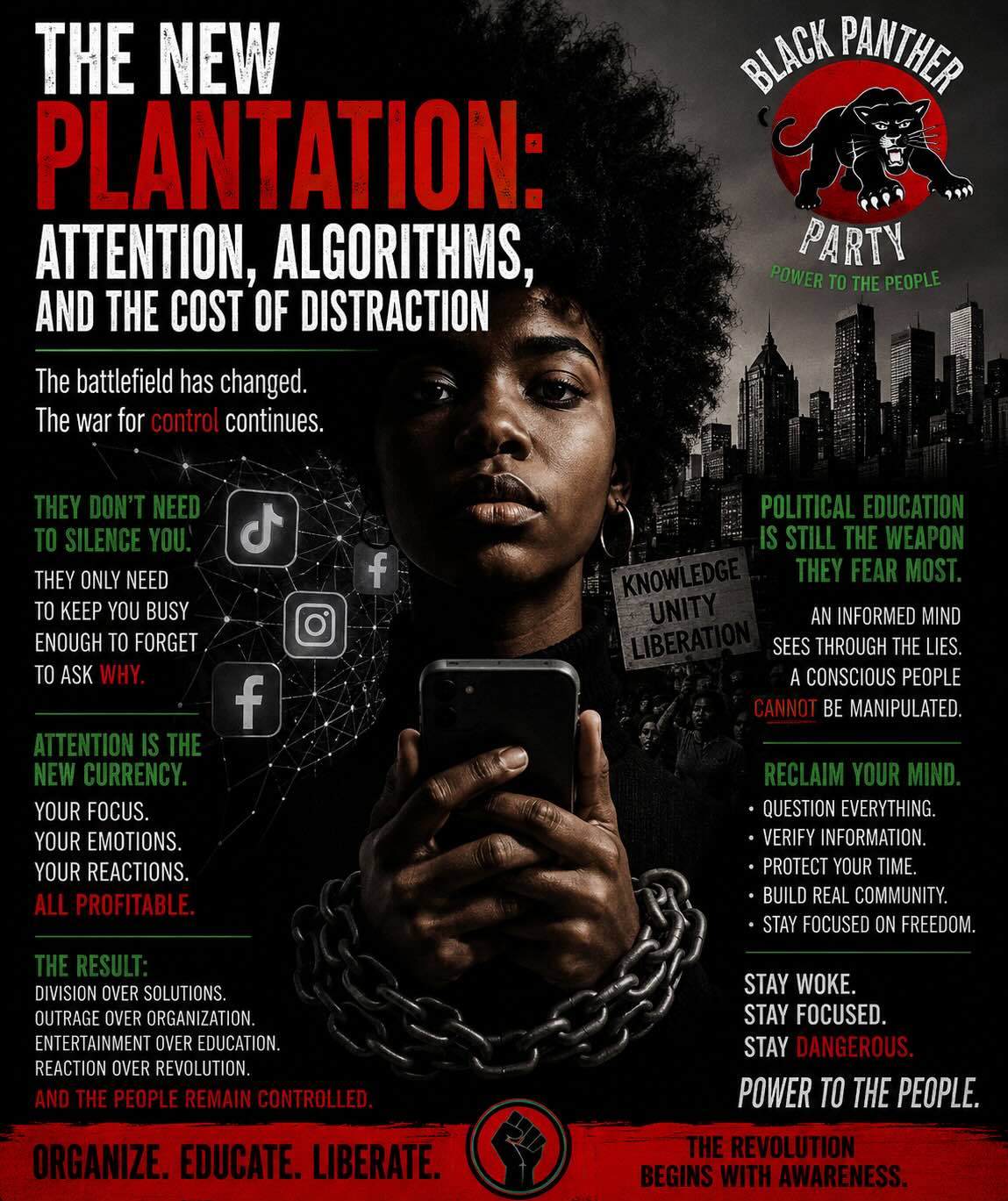
  • The New Plantation: Attention, Algorithms, and the Cost of Distraction

    The New Plantation: Attention, Algorithms, and the Cost of Distraction

    In every era, systems of power adapt.

    They rarely announce themselves as oppression. They arrive as convenience. As entertainment. As efficiency. As progress.

    The great battles of the 20th century were often fought over land, labor, housing, voting rights, education, and access to opportunity. The struggle was visible. People knew where the front lines were.

    Today, the battlefield is less obvious.

    It exists in our pockets.

    For the first time in human history, some of the most powerful institutions on Earth are competing not for territory, but for human attention. Attention has become a commodity. It is measured, purchased, analyzed, packaged, and sold.

    The longer you remain engaged, the more valuable you become.

    Every click is data.

    Every pause is data.

    Every reaction is data.

    Every moment of outrage is data.

    This reality raises an uncomfortable question:

    If previous generations were asked to defend their labor, their communities, and their political rights, what is our generation being asked to defend?

    Perhaps the answer is our consciousness itself.

    Political education was a cornerstone of the Black Panther Party because informed people are more difficult to manipulate. They ask questions. They challenge narratives. They seek evidence. They recognize when fear is being used as a tool.

    That lesson may be more relevant now than ever.

    We live in a culture where speed is rewarded over understanding. Headlines travel faster than facts. Emotional reactions often outrun critical thinking. Complex social issues are reduced to slogans, while algorithms amplify whatever keeps us scrolling.

    The result is not merely distraction.

    It is fragmentation.

    Communities become isolated from one another. Citizens become consumers. Neighbors become opposing teams. Public discourse becomes performance.

    Meanwhile, the deeper questions often go unasked:

    Who benefits from our division?

    Who profits from our outrage?

    Who gains when citizens are informed only enough to react, but not enough to organize?

    Justice has never been achieved through reaction alone.

    It requires study.

    It requires dialogue.

    It requires discipline.

    It requires the courage to think beyond what is trending.

    The struggle for equality in the 21st century is not only about access to resources, representation, or political power—though those remain essential. It is also about protecting our ability to think independently, to engage thoughtfully, and to remain human in a system increasingly designed to capture and monetize our attention.

    The challenge before us is not simply to consume information.

    It is to cultivate wisdom.

    Not merely to witness injustice.

    But to understand it.

    Not merely to criticize systems.

    But to build better ones.

    The question facing every generation remains the same:

    Will we allow ourselves to be distracted from the work of justice, or will we develop the awareness, discipline, and solidarity required to pursue it?

    Power has always depended on what people believe.

    Liberation has always depended on what people learn.

    Power to the People. ✊🏿
    #Justice #Equality #PoliticalEducation #MediaLiteracy #CommunityPower #BlackPantherParty #PowerToThePeople #SocialJustice #CivilRights #Consciousness #OrganizeEducateLiberate
  • 1968: The Report That Warned America

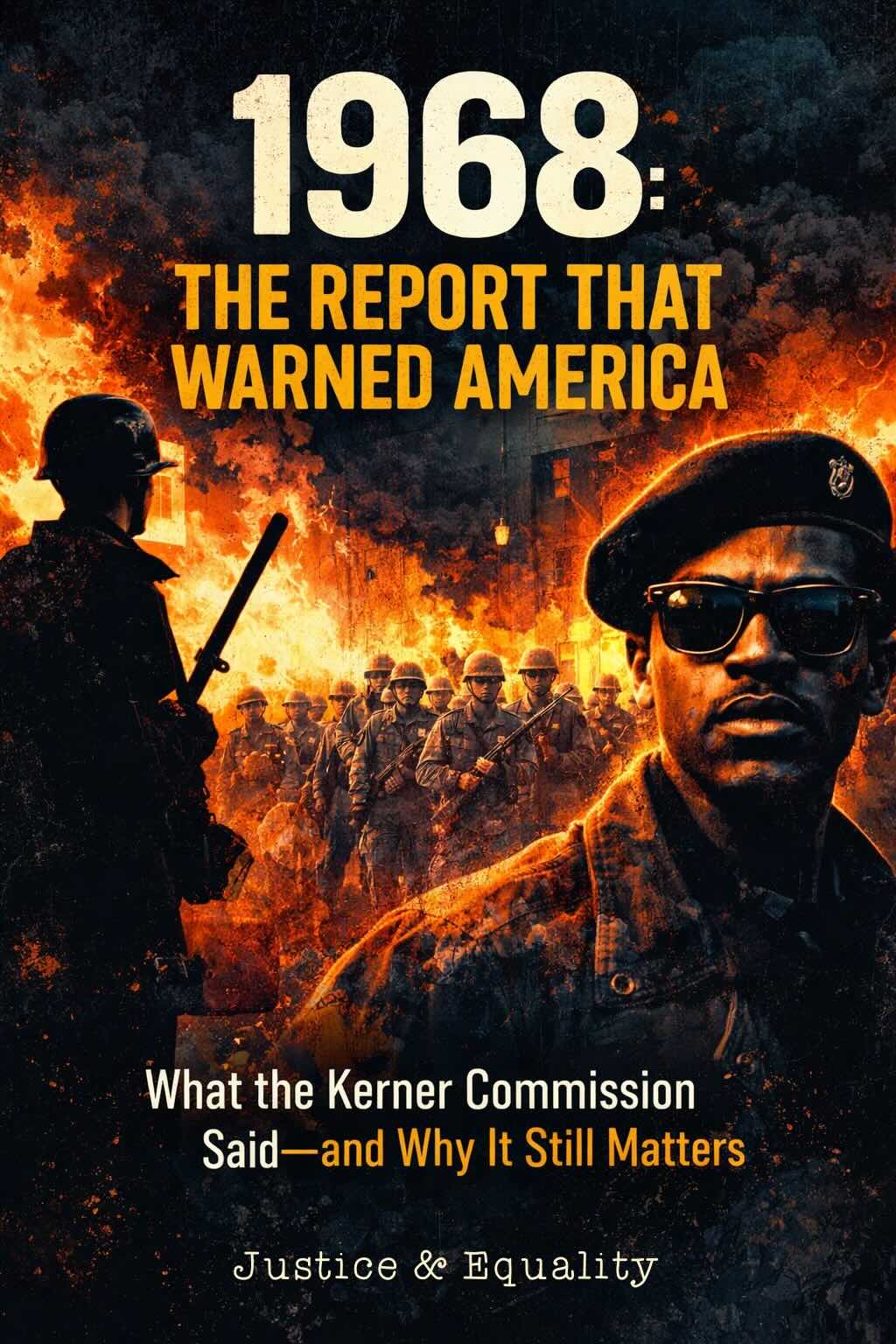
    1968: The Report That Warned America

    1968: The Report That Warned America

    What the Kerner Commission Said—and Why It Still Matters

    In 1968, the United States government conducted one of the most important investigations in its history.

    It asked three questions:

    • What happened?
    • Why did it happen?
    • What can be done to prevent it from happening again?

    The answers were clear. The warning was direct.

    America, the report concluded, was moving toward two separate and unequal societies.

    More than fifty years later, that warning still echoes.


    1968: The Report That Warned America breaks down the findings of the Kerner Commission and places them in context—what led to the unrest, what the government discovered, and what was never fully addressed.

    This is not an academic text.

    It is a focused, accessible look at a turning point in American history—and the questions that remain unresolved today.


    For readers seeking clarity, context, and a deeper understanding of the forces that continue to shape the country, this book offers a direct path into the conversation.

    JUSTICE & EQUALITY

    Cover of 1968: The Report That Warned America

  • A Black Jew Speaks, Pt. 2: The Credits Never Lie

    A Black Jew Speaks, Pt. 2: The Credits Never Lie

    Here’s another truth we need to talk about.

    If you watch any show—doesn’t matter what network, what genre, or what time of day—take a look at the credits. Really look. The producers. The writers. The directors. The studio heads.

    You’ll see a pattern. Jewish names. Over and over. Sometimes Eastern European. Sometimes obvious. Sometimes coded. But if you know what to look for, you’ll see it—and once you see it, you can’t unsee it.

    Now before anyone starts clutching pearls—this isn’t about hate. I’m Jewish. I know the names. I know the history. And I know what access looks like. I also know what exclusion feels like.

    Because here’s the thing: you don’t see that same energy for other communities. Where are the Garcias? The Watanabes? The Choudhurys? The Johnsons?

    You don’t see a balanced spread of Latin, Asian, Indigenous, or even Black creatives behind the scenes—not at the same scale. Not with that kind of consistency. And when you do see those names, they’re usually down the list. An assistant. A guest role. A “diversity hire.”

    Meanwhile, Jewish presence in media is everywhere—not just in front of the camera, but behind it, owning the entire machine. And yet, no one talks about it.

    Because the moment you even raise a question, you’re labeled antisemitic—even if you are Jewish. Even if you’re just pointing out what’s real.

    That silence? That fear? That’s not equality. That’s protectionism. That’s unchecked power. And it’s not reflective of the actual society we live in.

    I’m not mad that Jews are represented in media. I’m mad that everyone else isn’t.

    Because real diversity isn’t just a hashtag. It’s not just casting a Black lead and calling it a day. It’s about who holds the pen, who funds the project, who gives the greenlight, and who owns the lens you’re seeing the world through.

    I’ve been in those rooms. And I’ve seen the difference between walking in as Craig Cohen versus Justice Jones. One name opened doors. The other got raised eyebrows.

    That’s not just bias. That’s built-in.

    So yeah—the credits never lie.
    And maybe it’s time we actually started reading them.

  • A Black Jew Speaks: Enough Already

    A Black Jew Speaks: Enough Already.

    Let me be clear, because I don’t want there to be any confusion: I am Jewish. I come from Kohans—one of the oldest priestly lines in the culture. I’m also Black. And I’m done being quiet.

    I’m tired of seeing the Jewish story dominate every narrative about pain and suffering—especially here in America. I turned on PBS today, and once again, it was another Holocaust special. And sure, the Holocaust was horrific. It was evil. But damn it, it happened eighty years ago.

    Meanwhile, Black history in this country gets erased, minimized, and dismissed. We still can’t get real airtime for the transatlantic slave trade, the genocide of Native Americans, or the ongoing trauma of being Black in America. Where’s that programming?

    And here’s the kicker: while we’re being told to “never forget,” the State of Israel—our so-called answer to Jewish persecution—is wiping Palestine off the map in real time. Right now. Today.

    And yet, no one is allowed to talk about that without being labeled antisemitic. Even when the critique is coming from inside the house.

    Let’s stop pretending Jewish power doesn’t exist. It does. In media, in law, in medicine, in politics. That’s not a conspiracy. That’s reality. And when you have that kind of power, you should be held accountable like anyone else.

    Not shielded by historic trauma forever. We can’t keep using our pain as armor to ignore the pain we’re causing.

    And don’t even get me started on how we police who’s “really” Jewish. As a Black Jew, I’ve been questioned more times than I can count.

    And yet, when I used the name Craig Cohen in the Hollywood scene back in the day, doors flew open. More callbacks. More access. More attention—until I showed up in person and the assumption collapsed.

    That tells you everything about how whiteness functions within Jewish spaces. Jewishness gets respect—until it’s attached to Blackness. Then suddenly, you’re “not really Jewish,” or worse, invisible.

    This isn’t hate. This is truth.
    And I’m done being polite about it.